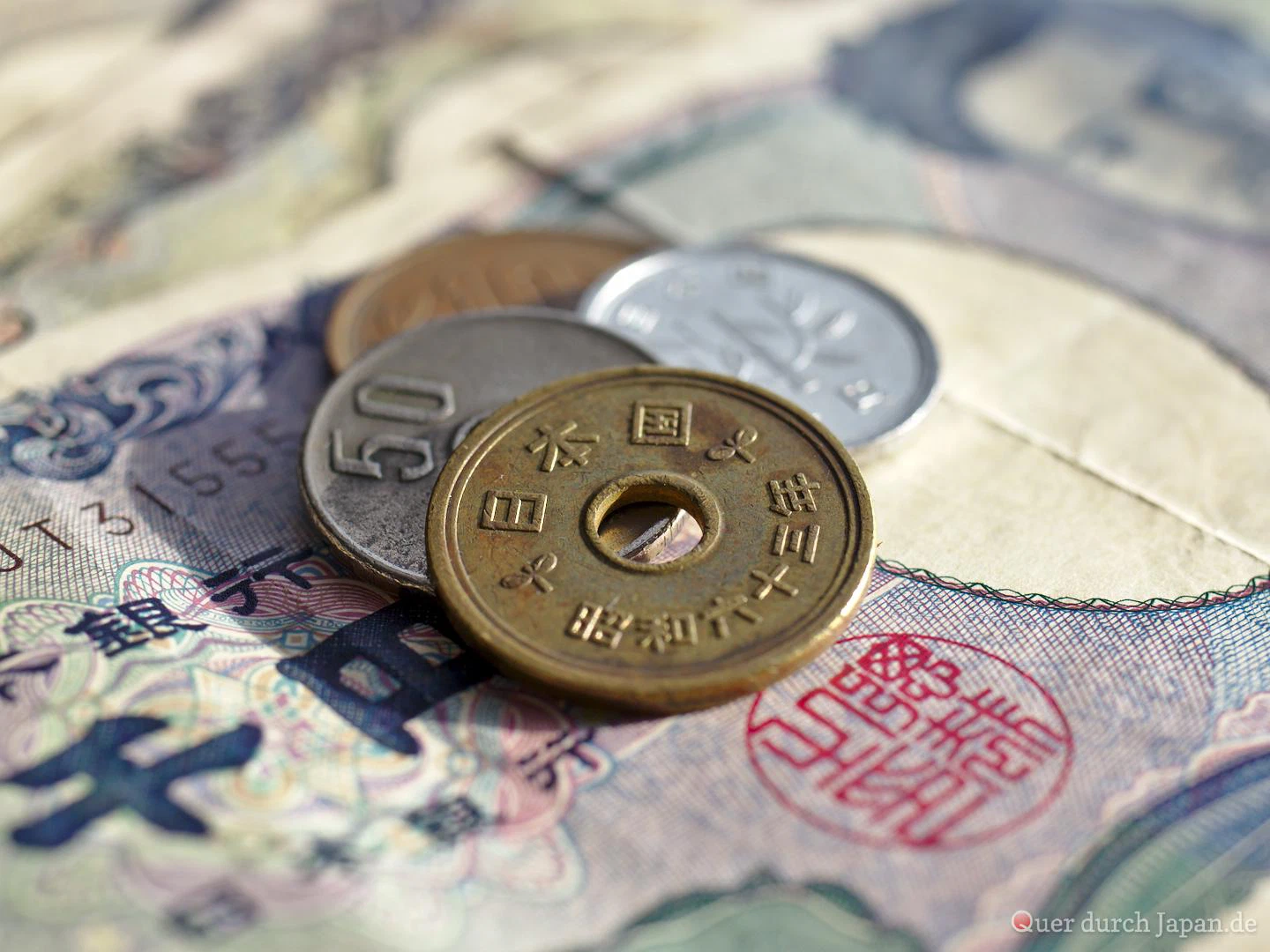
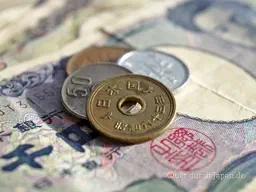
 The Japanese currency is called the yen. Internationally, the symbol ¥ is used for it. In Japan, however, you’ll only find the kanji 円 (pronounced “en”), which actually means circle. There are no cent amounts; the smallest unit is 1 yen, which is very roughly equivalent to our Euro-cent.
There are coins and banknotes. The smallest coin is the 1-yen coin, and the largest is the 500-yen coin. All notes and coins have their value printed in Arabic numerals. The only exception is the 5-yen coin, which is just stamped in Japanese with 五円.
The notes aren’t as easy to tell apart by colour as the Euro and are almost all the same size. So it’s pretty easy to mix up a 1,000 yen note with a 10,000 yen note if you aren’t paying attention.
Changing money
In my personal experience, it’s hard to buy larger amounts of yen for a trip in Germany, especially at good rates. But what’s it like in the destination country itself?
Travel guides for all over the world always warn against changing money right at the destination airport, because the exchange rate there is usually rubbish and the fees are high. This doesn’t apply to Japan. At the international airports, you’ll find bank exchange counters that change cash at a fair daily rate and without exchange fees, even for larger amounts. A quick comparison of the displayed exchange rates is still worth it, though.
A lot of hotels offer to change cash into the local currency at reception, but the rates aren’t quite as good. Some hotels even have a currency exchange machine for this purpose.
Of course, you can also change your money at a Japanese bank, but that can be a pretty time-consuming hassle, as forms have to be filled out and signed off by several staff members. There are nicer things to do on holiday than wasting your time in a bank.
In the Seven-Eleven supermarkets, which seem to be absolutely everywhere, you can withdraw money from the cash machine (“ATM”) using major credit cards. Depending on your own card’s terms and conditions, this can be the cheapest way to get your hands on cash.
Plastic money
Japan is very much a cash country. Generally, credit cards are only accepted by large department stores, hotels, international fast food chains, and ticket machines. For everything else, you should make sure you have enough cash on you to avoid any nasty surprises.
Even though you’re usually on the safe side with Mastercard or Visa, it’s better to check before booking whether the hotel you want accepts your credit card issuer. Some hotels and car rental places also require a proper credit card and reject debit cards. If you’re relying on paying by card, you should have a real credit card with a sufficient limit to fall back on just in case.
There are loads of domestic payment systems in Japan that are inaccessible to tourists. In branches of larger chains, you can still try paying contactlessly with your own credit card, Apple Pay, or Google Pay. At the till, you should just say “Visa Touch” as the payment method, even if you have a Mastercard. You shouldn’t rely on it, though.
Tip: Before you travel, you should let your bank know in good time about your upcoming trip abroad!
Cash withdrawals by card outside Europe are blocked by some banks for security reasons and need to be unblocked for the duration of your stay. Plus, the bank will then know about your trip and won’t accidentally block the card on suspicion of fraud.
While you’re at it, you can also find out about the fees and daily limits.
Banks also often temporarily grant a higher limit on your credit card for a holiday. It’s definitely worth asking.
Prices
Prices are usually written in normal Arabic numerals, so you can easily read them as a tourist. Every now and then, however, you’ll also spot price tags with Japanese numerals. The system isn’t hard to get the hang of; a little cheat sheet helps a lot.
While over here in Germany prices always include VAT, that’s not necessarily the case in Japan. Sometimes two amounts are displayed - the price without tax (税引) and with tax (税込). The VAT rate in Japan is currently 10% (as of October 2019), with a slightly reduced rate if you take food away instead of eating in.
Tipping
It’s true: you don’t tip in Japan. Good service is taken for granted and you don’t need to pay extra for it. Tipping isn’t expected either, so you shouldn’t even try; it often just causes confusion.
Leaving the country
When leaving the country, you can change the money back into your home currency at a fair rate at the exchange counters at the airport. However, you only get notes, no coins.
Or you can just take the remaining money home with you for your next trip to Japan. 😉
The amount of cash you can bring into Japan and back home without declaring it is limited. The limit is relatively high, so even a generous holiday budget will usually not need to be declared. It’s still a good idea to check the latest regulations with your Foreign Office and your Customs Auhtority.