Sometimes it’s the unplanned things on a trip that really stick in your memory.
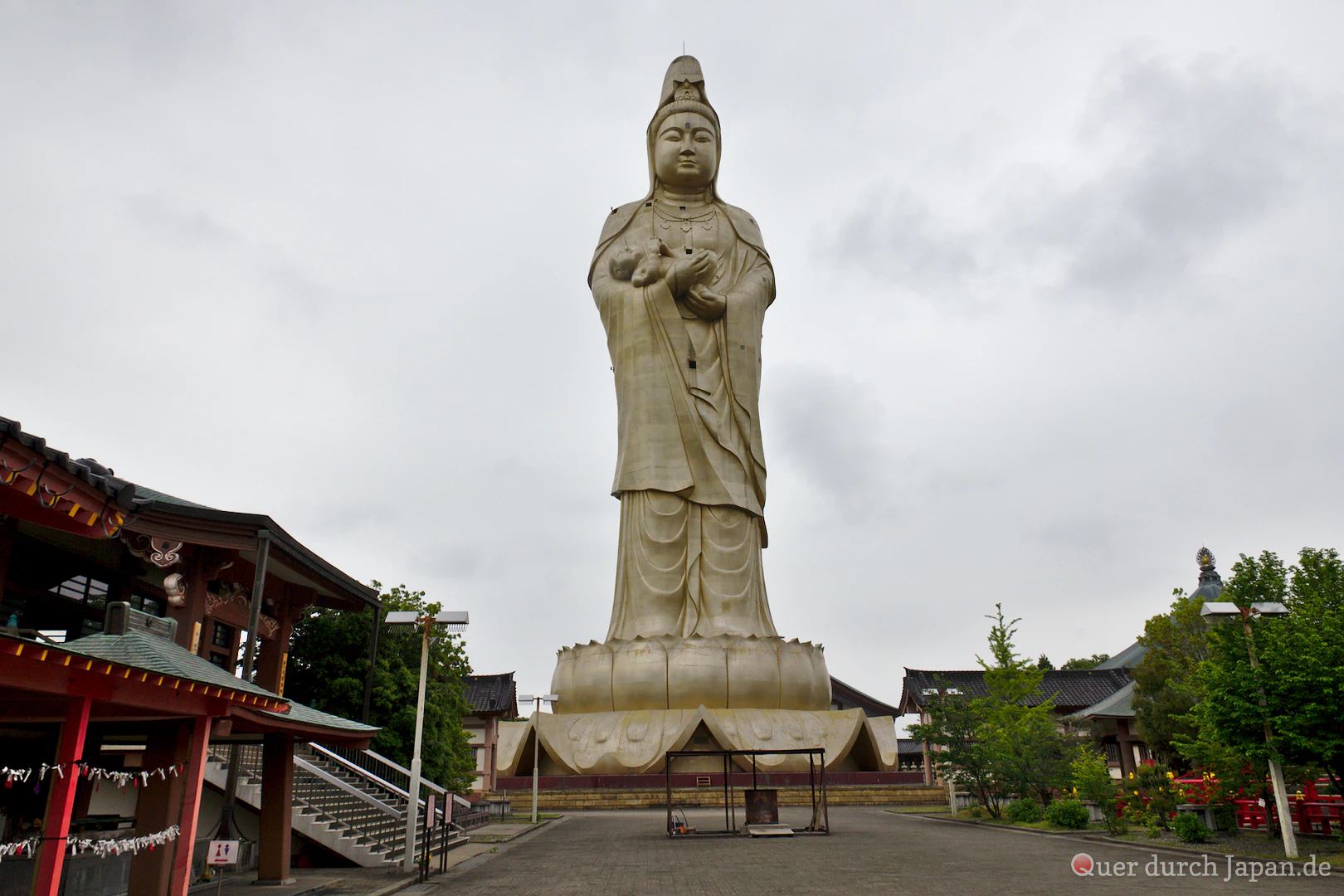
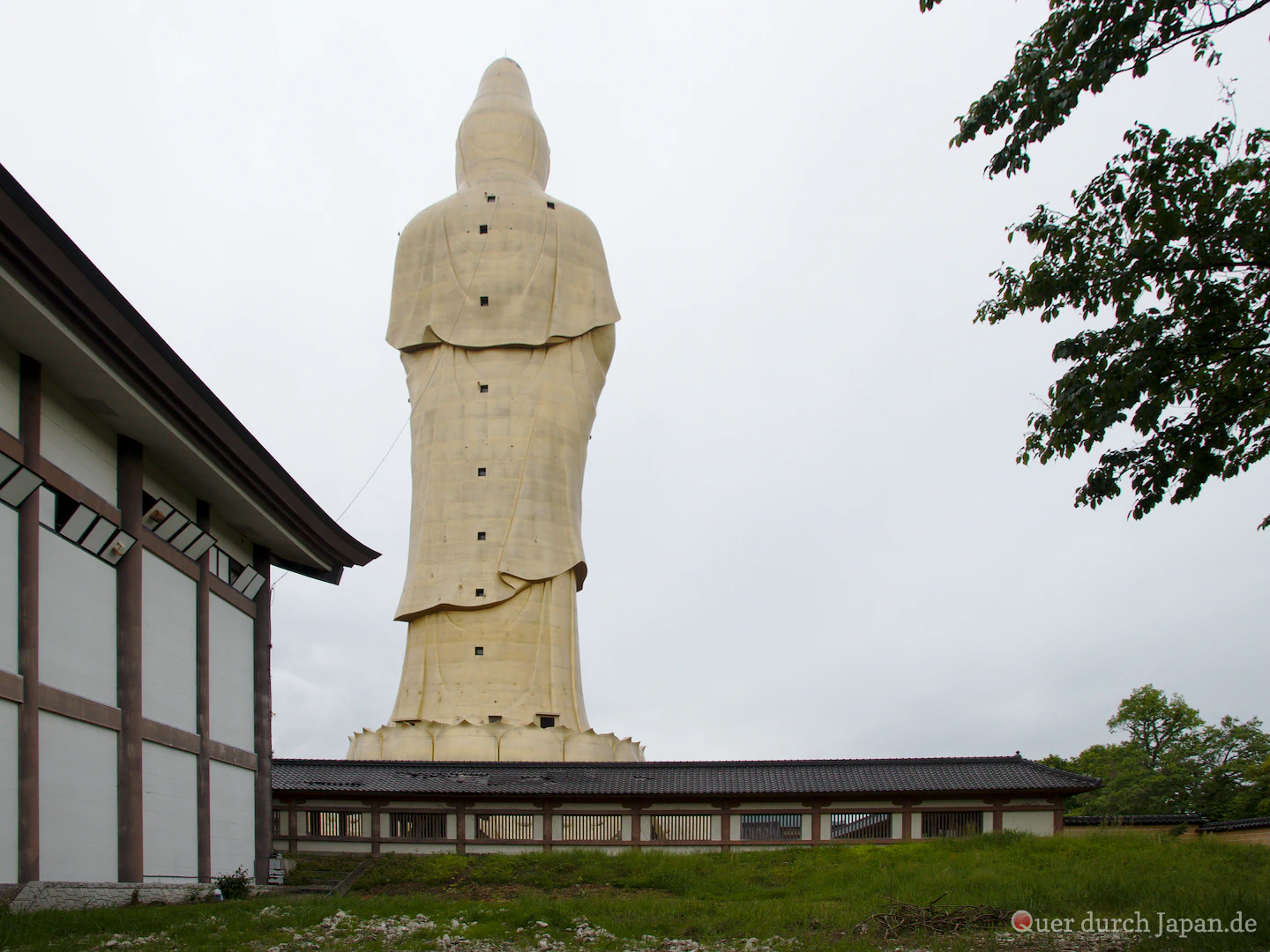
On our train journey from Kyōto to Kanazawa, our train passed through the little town of Kaga-Onsen. At first glance, it was a normal little Japanese town, if it hadn’t been for the massive golden Kannon statue standing on a hill, gleaming in the sun.
We got curious. At our hotel in Kanazawa, we tried to find out more about this statue, but the place wasn’t mentioned in our travel guides. What we did find was a tourist’s post on an internet forum saying he only found a half-ruined temple complex there.
That doesn’t exactly sound like a tempting prospect, but for photographers, ruined buildings have their own special charm. We looked up the statue on Google Maps and plugged the coordinates into our GPS. Then we set off for Kaga-Onsen.
Onsens are hot volcanic mineral water springs. You can find them almost everywhere in Japan. Hotels that have popped up around them use these springs to offer their guests a spa stay with baths, good food, and cosy rooms. During the Japanese economic miracle, there were lots of these places where people could spend their sparse holidays and relax. When the economic crisis hit, people didn’t have the money for expensive holidays anymore, and the places fell into oblivion.
The same goes for Kaga-Onsen. In 1987, “Utopia Kaga no Sato” opened here, a leisure complex with an onsen hotel, an amusement park, and this very temple. Today, not much of that is left to see. There weren’t any signposts left, so we found our own way. It took us in an arc around the statue, past the former hotel and a scrapyard where the amusement park used to be. Eventually, we made our way into the temple through the back.
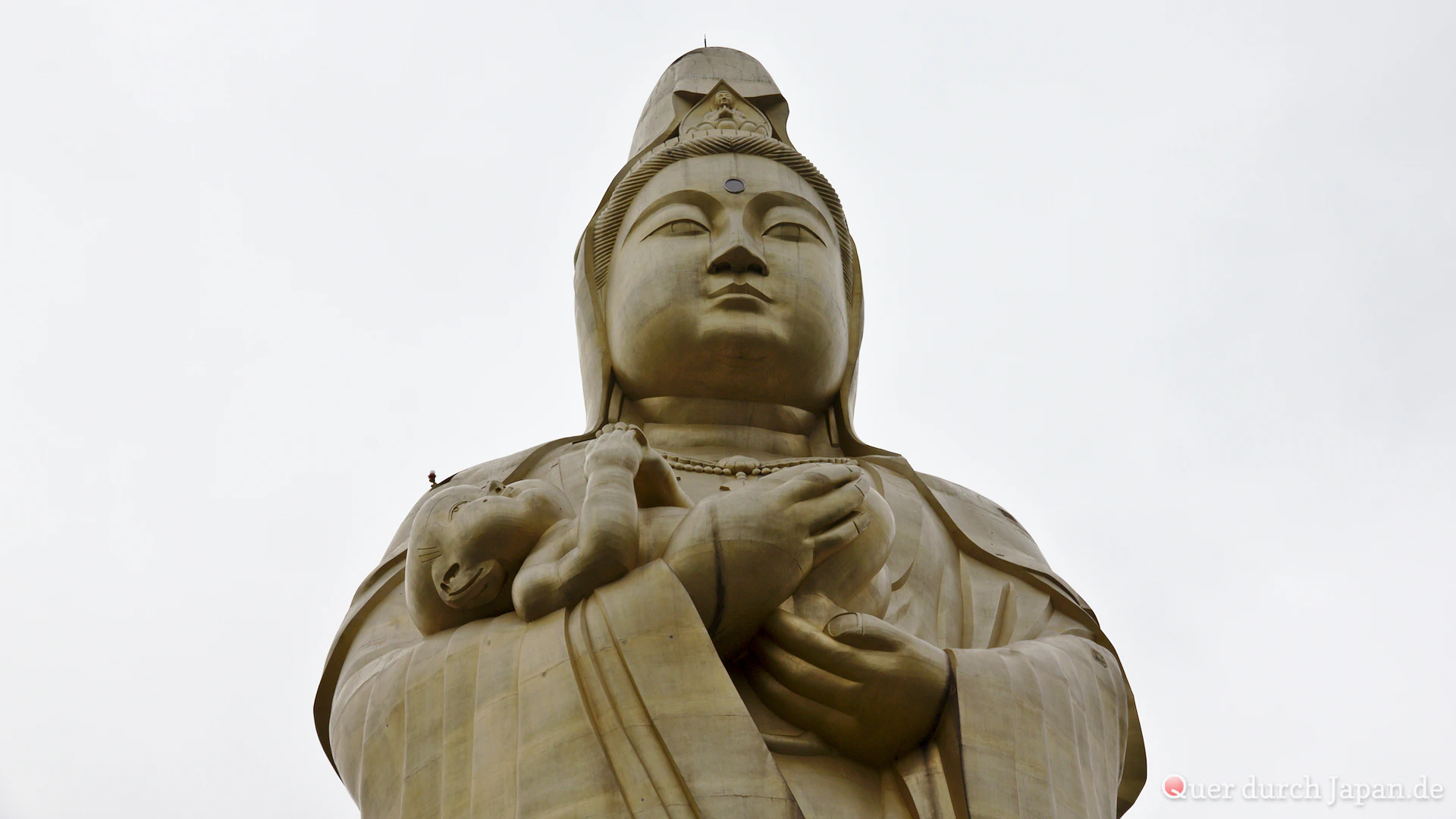
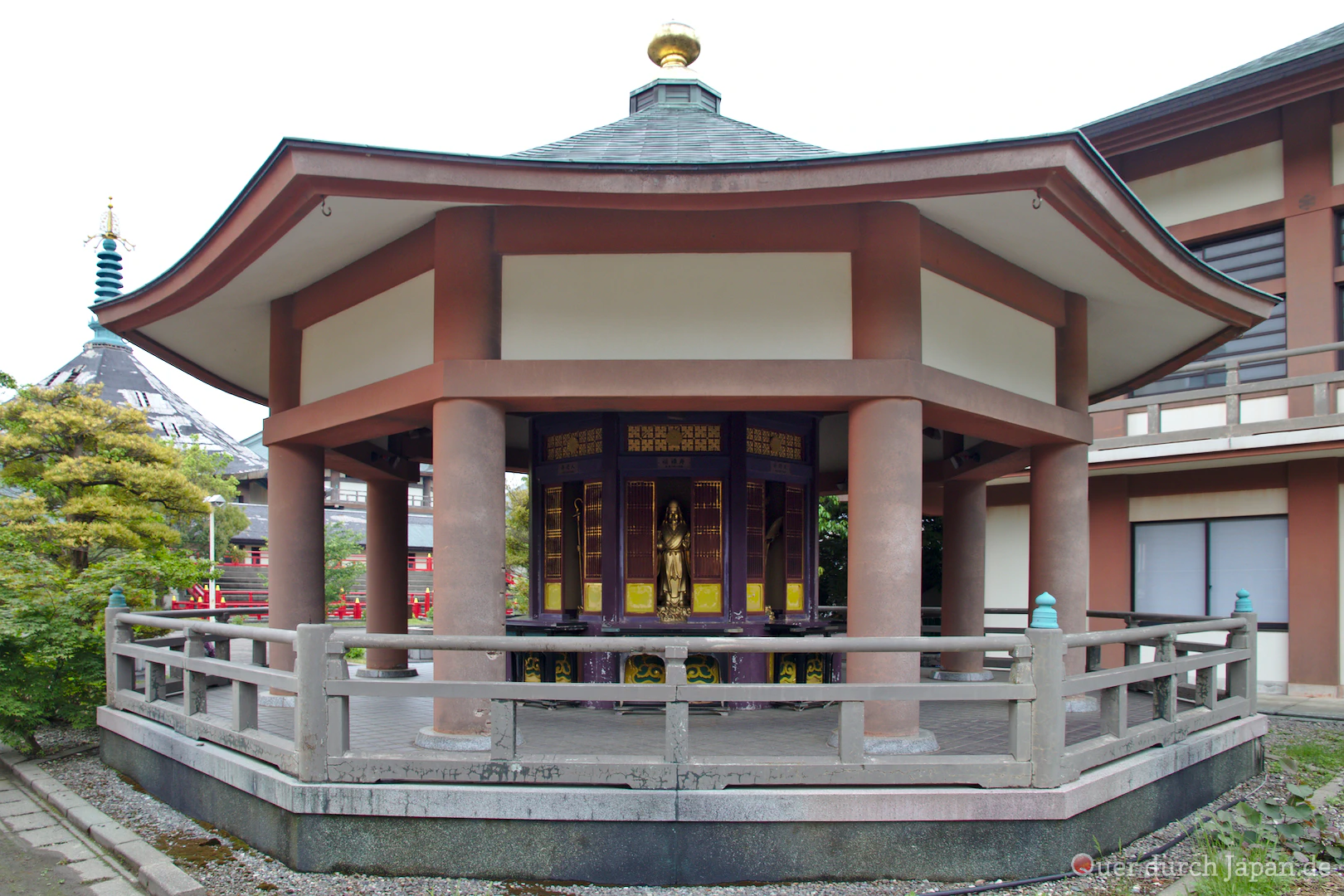
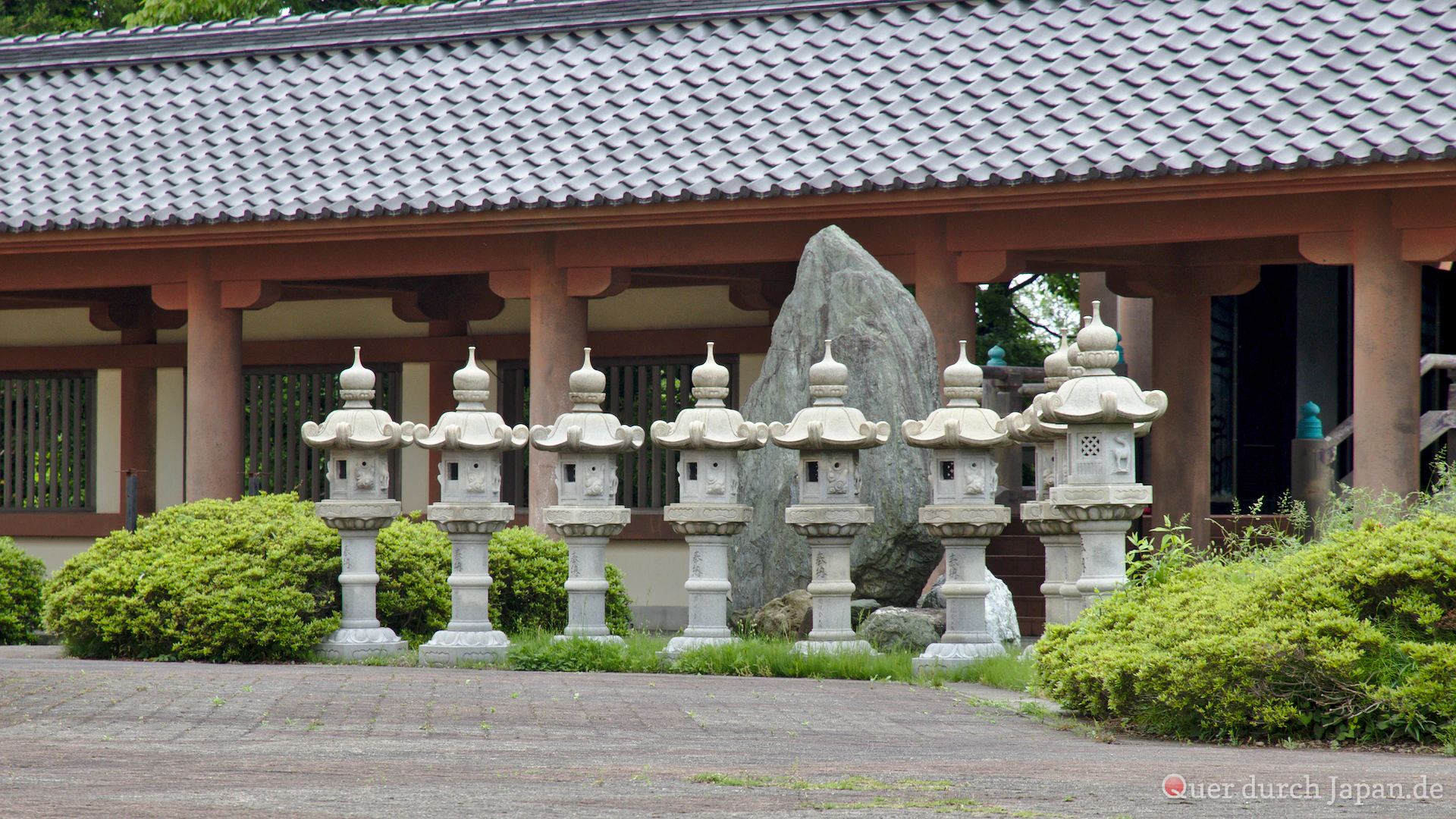
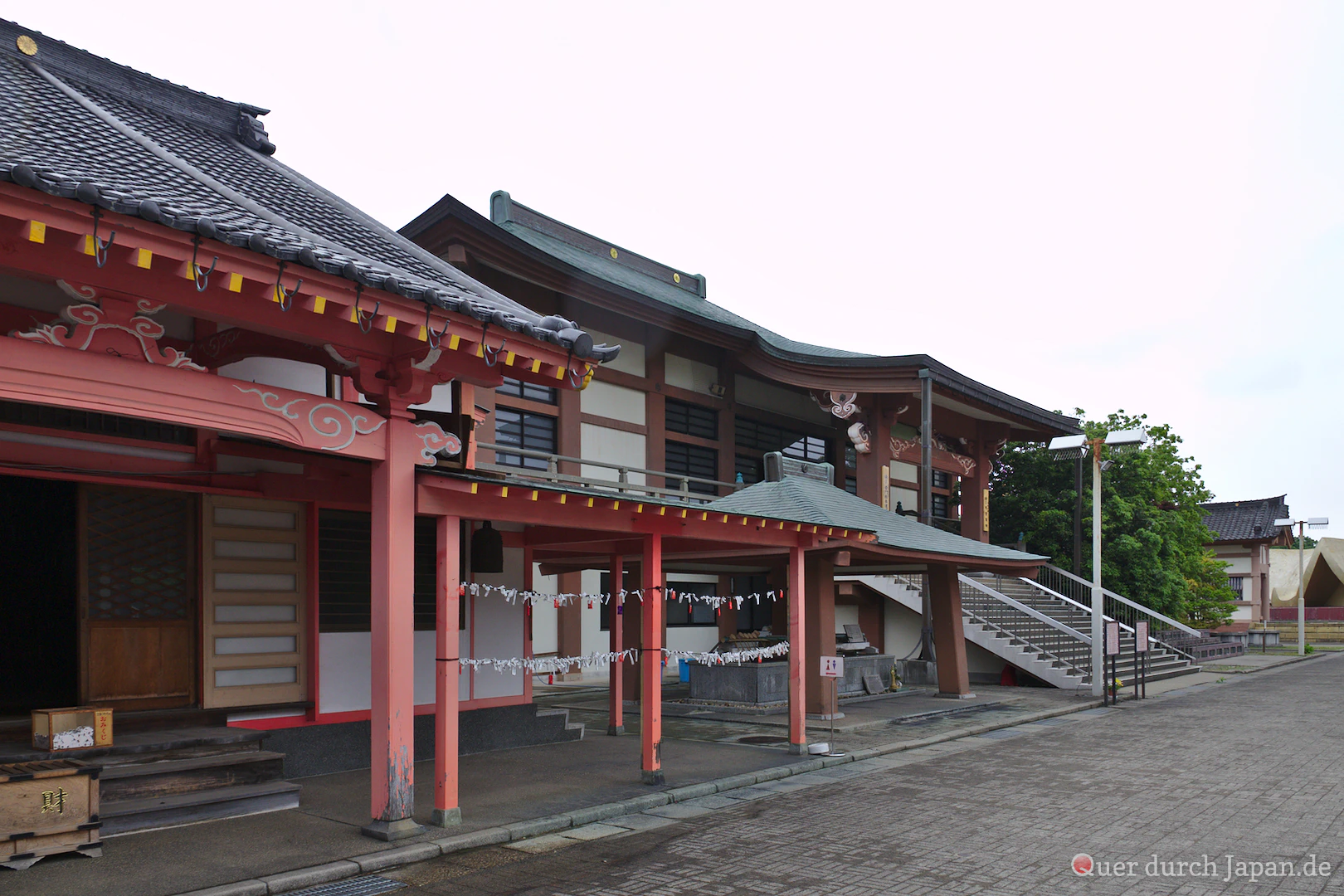
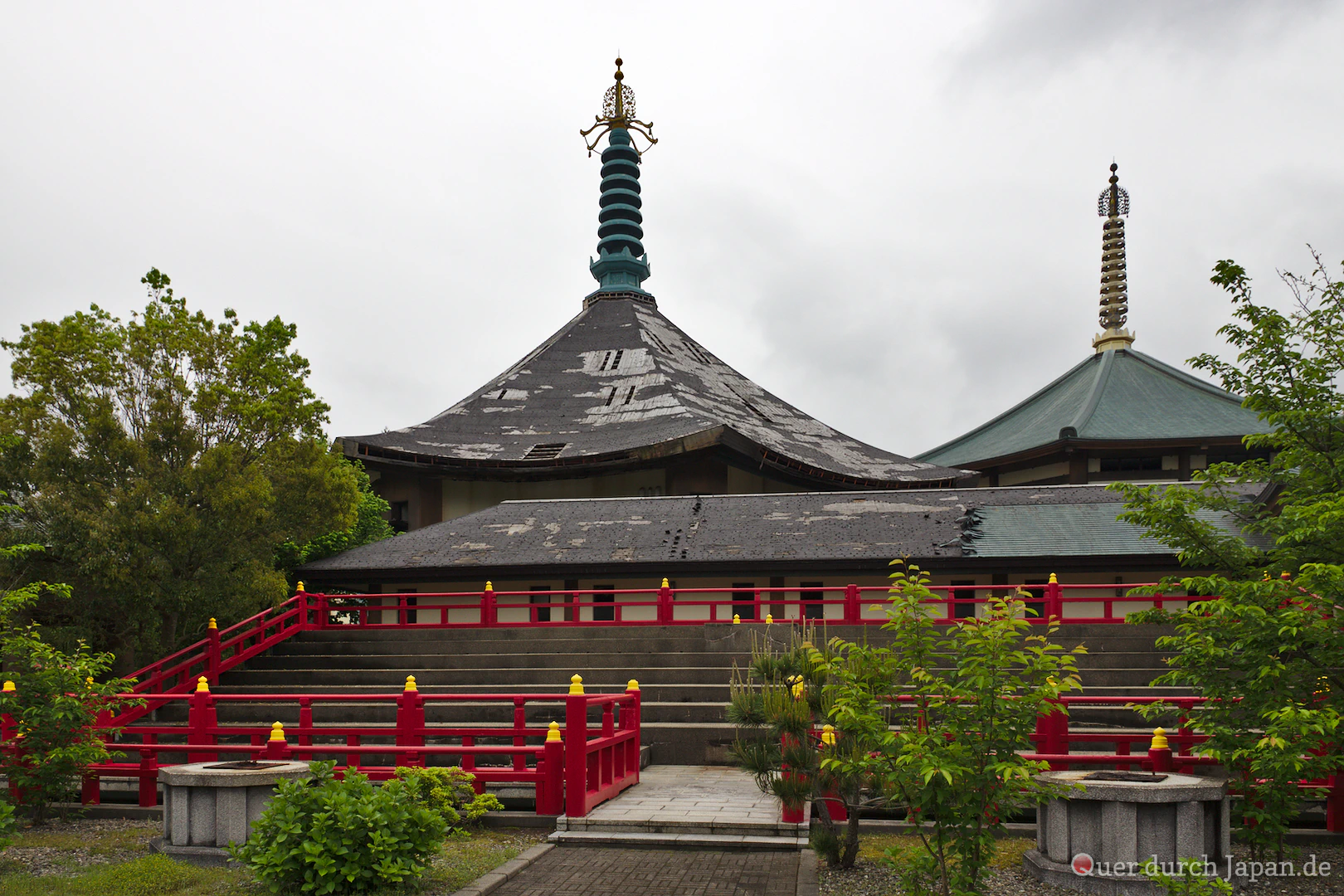
And there she stood in the middle of the complex, Kaga Kannon, the 73-metre-high Kannon Bodhisattva with a child on her arm. Around her were several small buildings. A covered circular path led around the base of the statue to a hall that looked like a barn at first glance. The complex had undoubtedly seen better days. Here and there the paint was peeling, and some roofs actually had big holes in them, while other buildings seemed intact. You could clearly tell that someone was trying their best to keep the place maintained on a tight budget.
To our surprise, there were other people there. Gardeners were trimming a hedge. Another tourist couple was strolling along the buildings. The temple caretakers waved us over. Even though we had accidentally sneaked in through the back door, we were given a friendly welcome.
Of course, we paid the 500¥ entry fee per person that would have been due at the regular entrance. In return, we got an extensive guided tour. Unfortunately, our guide only spoke Japanese, but we managed with Google Translate and my rudimentary Japanese skills. We went into the building I had just mistaken for a barn. Inside the hall, the life path of Buddha was depicted in large dioramas with immense attention to detail, and in front of that, on a gravel area, was a model landscape with tiny buildings and figures.
That sight was pretty breathtaking in itself, but nothing compared to what awaited us in the other half of the building. Standing there on a grandstand were 1,188 golden, life-sized Buddha figures. We’d seen something similar in Kyōto at Sanjūsangen-dō, but even though that one is definitely more significant from a historical point of view, this one was much more magnificent with its golden gleam and the mirrors on the wall.
In another outbuilding hung a 10-metre-high and 5-metre-wide bell featuring figures of heavenly animals. Naturally, it was also gold-plated. Just like the 17-metre-high, 5-storey pagoda in yet another building. We just couldn’t stop marvelling at what gems were hidden in this somewhat run-down place. It was a shame that taking photos wasn’t allowed inside the buildings.
Totally overwhelmed, we left the temple complex again, this time through the main entrance. And so an unplanned detour to a neighbouring village turned into a really special experience. Not just for us, but also for our hosts, who were thrilled to have visitors all the way from Germany.
The main entrance can only be reached via a somewhat hidden, short dirt track. But it’s worth dropping by Kaga no Sato if you happen to be in the area and have some time to spare.