#Sprache

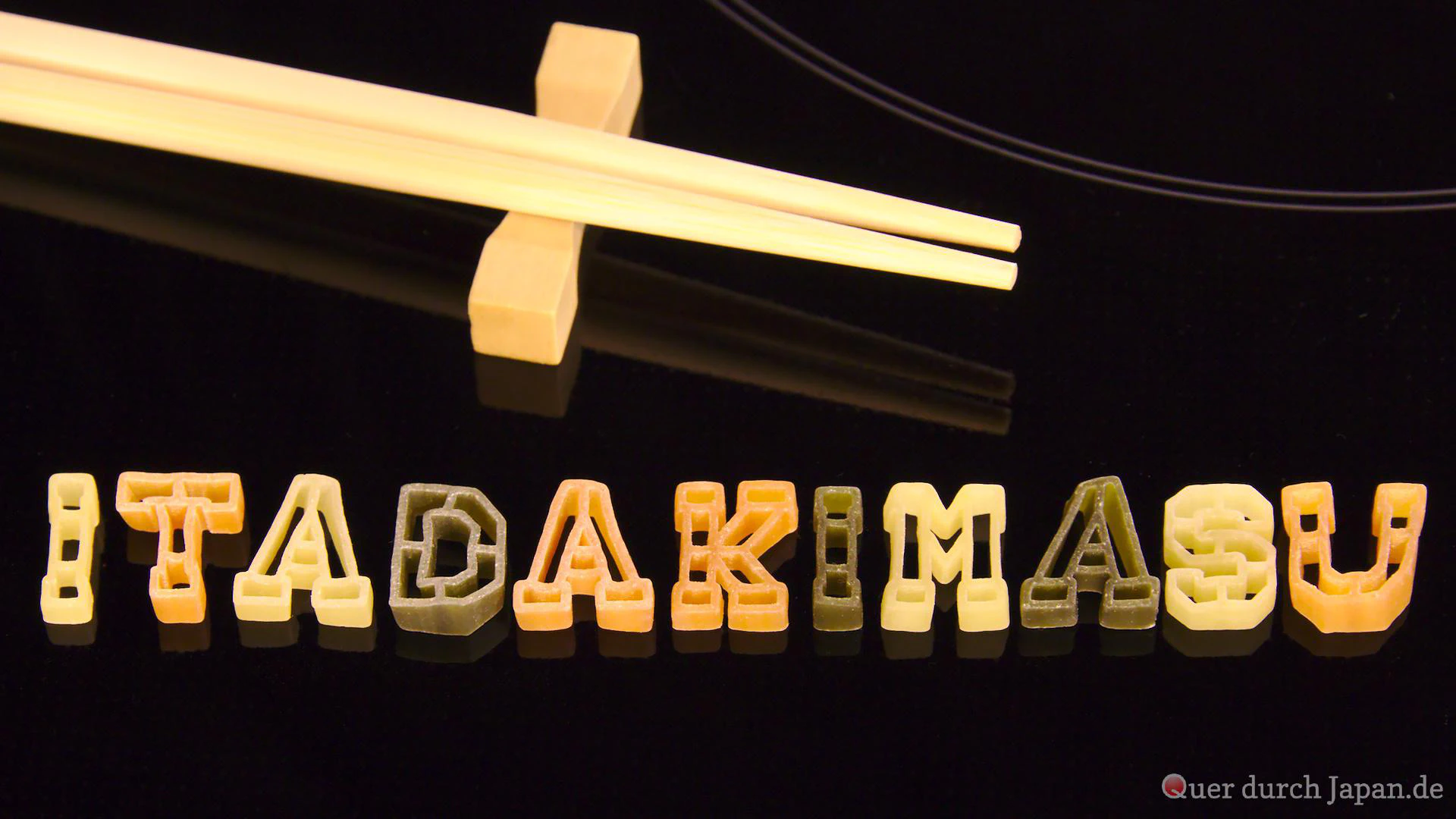
Itadakimasu!

A look at the phrasebook tells you that “enjoy your meal” in Japanese is いただきます (itadakimasu). But there’s a lot more to it.

With “enjoy your meal”, we’re just wishing the others at the table a tasty meal and a nice time eating together.

Itadakimasu, on the other hand, is an expression of gratitude. You’re thanking the plants that were harvested for the food, and the animals that gave their lives for it. You’re saying thanks to the emperor, your parents, the farmer, the fisherman, the cook, and basically everyone who pitched in so you can tuck into a delicious meal right now. You’re realising that this isn’t something to take for granted. If you take the idea seriously, it also means eating absolutely everything, right down to the last grain of rice.

The original meaning of itadakimasu was “to raise something above your head”. Buddhism brought the custom to the country of taking an object received from a superior and holding it above your head first, as a sign of gratitude and respect. Over time, this turned into a general expression for politely receiving an object.

Using it before eating is pretty new, though. Up until the early twentieth century, it was only a regional thing before it caught on nationwide. Even today, whether you put your hands together while saying it or not varies depending on the region.

PS: At the end of a meal, you say ご馳走様でした (gochisōsama deshita) - “That was a feast.”
Über die Aussprache

Japanese actually uses three writing systems. None of them match our alphabet. So to make reading easier for us, there are various transcriptions that represent Japanese words in Latin letters. The most famous ones are the Hepburn system and the Kunrei system used in this blog.

With this, the word 東京 becomes Tōkyō, for example. So we can read it now. But how do you pronounce it right? And what do those lines over the O mean?

From a German speaker’s perspective, we’ve got a bit of an advantage, ‘cause you can basically pronounce Japanese words as if they were German. For a start, you only need to look out for a few exceptions:

  • The J is pronounced “j”, like in “jungle”.
  • The R is pronounced like a mix of R and L. That takes a bit of practice.
  • The S is pronounced a bit sharper, like an “ss” (or “ß”).
  • At the end of a word, a U is usually just hinted at, “desu” is pronounced “dess” for instance.
  • The Z is pronounced like our S.

Vowels are always pronounced short. If they need to be lengthened, there’s a macron (ō) or sometimes a circumflex (ô) over them. We can think of it like an added silent H. So:

  • 東京 → Tōkyō → Pronounced: Tohkyoh
  • 京都 → Kyōto → Pronounced: Kyohto
  • 大阪 → Ōsaka → Pronounced: Ohssaka
  • 横浜 → Yokohama → Pronounced: Yokohama (not “Yoh-koh-hah-ma”)

By the way, alongside their three writing systems, Japanese students also learn our Latin alphabet, called rōmaji over there. But it only plays a minor role in everyday life.

Engrish

On the internet, you can find more or less funny blunders under the term Engrish, which happen because the letters R and L get mixed up. What’s the deal with that?

We all acquire our basic language skills in early childhood. For native German speakers, “vier” and “viel” are two completely different words, because we’ve learnt from childhood to tell them apart by their sound.

The Japanese language doesn’t distinguish between the R and L sounds. It only has a mixed sound, as we saw above. So for Japanese foreign language students, words like “vier” and “viel” (or even English ones like “right” and “light”) sound pretty much the same at first. They have to painstakingly learn the difference.

You can find out for yourself just how hard that is for an adult in this YouTube video. The Chinese word “ma” means “mother”, “hemp”, “horse” or “scold” - depending on the intonation. A native Chinese speaker hears four totally different words here, while to our ears they sound kinda the same. From our perspective, a minor mistake in intonation can already result in calling your mum a horse.